Our team was stoked to put together an expert panel for CES Conference 2026 called “RFP Wi$h Li$t: Evaluation Consultants Read Between the Lines.” This panel was all about unpacking what we find perplexing and frustrating in the world of RFPs. Together, we explored what consultants actually look for when interpreting RFPs, what makes an RFP helpful (or headache-inducing), and how greater understanding between RFP issuers and consultants can lead to better partnerships.
Whether you attended the session or missed it, we’ve shared the presentation resources and downloadable materials below for both consultants responding to RFPs and those issuing them. Let us know if you find these useful, and if there’s anything else that we should link to.
Our wish list!
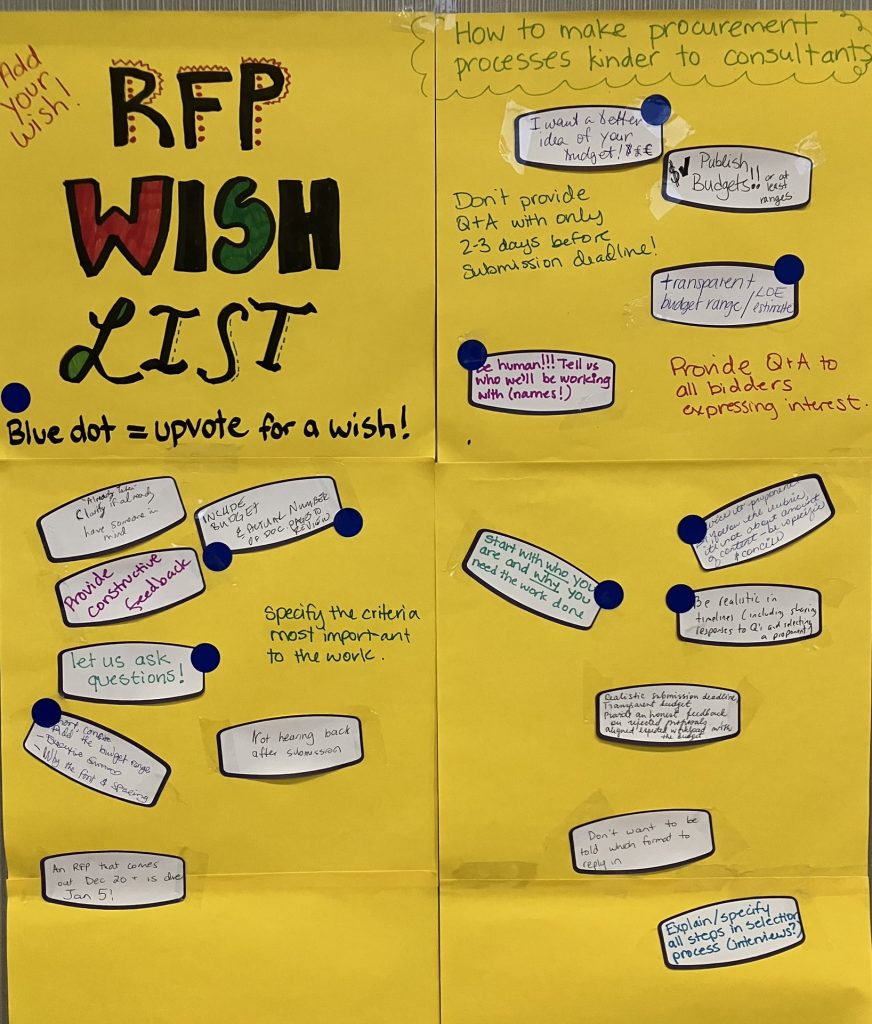
See below for the wish list we created together at the conference. Between this list and our expert panel, the discussion highlighted what evaluation consultants want RFP issuers to do more of:
- Before you write your RFP, talk to us. Reach out to consultants and ask to talk through what you need or are thinking about. We can help you think through key details and options, which can help you clarify your request — including whether an open RFP is the right process for you. If you must go the RFP route to comply with organizational or funder requirements, we’re more likely to submit a response if we’ve already made a positive face-to-face connection with you.
- Be transparent about budget. At minimum, provide a budget range, and specify what all is to be included and excluded (taxes, travel, other expenses). Consultants need to know this so we can fairly assess whether we have the capacity to take on this work in a way that will meet your expectations. Not providing a budget immediately screens out excellent consultants who decide it’s not worth the cognitive load to guess at what your expectations are.
- Provide critical information in the RFP. Start with describing who your organization is and why this work is needed. If similar or foundational work has been done for your organization, mention this. Specify project timelines, including what’s firm and what’s flexible. And what are your timelines and process for reviewing bids? It can be helpful to use a checklist to ensure you’ve included what’s critical — see our resource below.
- Specify the knowledge and capabilities essential for the work. Be clear in what you consider absolutely essential, and what’s just “nice-to have” — and provide a rubric to show us how you’ll rate and weight these criteria. Side note: You might have a very specific consultant in mind you want to work with and you’re trying to signal this in your RFP (see our resource below, “5 signs an RFP is intended for a specific vendor”). But if this is not the case, leave the door open for bidders to demonstrate how their experience is applicable and relevant.
- Make submitting easy. Proposals are a way for us to showcase what our deliverables can look like, so let us have flexibility in the format. A list of content and sections you’re hoping to see covered in a proposal is sufficient guidance. Don’t go so far as providing a specific form that we’re required to work within, or request that we write mini essays on several topics to demonstrate our knowledge. And don’t require us to submit through a clunky RFP platform (here’s looking at you, Biddingo) — keep it as straightforward as sending an email.
- Be human, accessible, and ready to answer questions. Good evaluation work requires trust and strong relationships. Please don’t hide behind the veneer of procurement processes. Make yourself available for a meeting before the submission date. Tell us who we’ll be working with (include names!). Publish Q&A and circulate to all interested bidders. Give respondents time to factor the Q&A into their submissions (more than a couple of days!). Allow ample time for submissions and be aware of weekends and major holidays (contrary to what some may think, consultants don’t work 24/7).
- Provide all bidders with a response regarding the outcome. Offer a debriefing session to bidders and be ready to substantiate your decision. Tell us about the most important factors in your decision. If you have constructive feedback, share it. Be open to using this as a time to build relationships with prospective vendors who you might work with in the future.
Resource: Checklists for organizations issuing RFPs
Another resource from us: 5 signs an RFP is intended for a specific vendor
Other resources we like
These resources have inspired our work. Check them out!
- Whitepaper: Hiring an evaluation consultant (by Usable Knowledge): A guide for non-profits (but useful for any organization) to help them make the most of hiring an external evaluator.
- Evaluation Capacity Diagnostic Tool (by Informing Change): Helps organizations assess their readiness to take on many types of evaluation activities.
- Article: What to include in your evaluation RFP (by Three Hive): Useful quick tips, plus a link to a downloadable checklist for what to include in your RFP.